Hydropower
Accurate predictions of freshwater discharge from the Greenland Ice Sheet are increasingly important for hydropower planning. Together with our key stakeholder Asiaq - Greenland Survey, we have developed a Functional Time Series (FTS) module within DTC-IS that predicts proglacial discharge from a key land-terminating Greenland catchment relevant to planned hydropower expansion. While increased summer melting may temporarily boost electricity production, long-term changes could reduce steady inflows in key areas. Planning resilient hydropower systems for a warming climate therefore depends on understanding how ice-sheet hydrology will evolve.
Try the notebook
Coming soon.
Use the code
Coming soon.
The model is driven by a probabilistic datacube constructed within the digital twin using a Gaussian Random Field (GRF) module, which integrates multiple meltwater-relevant Earth Observation datasets on a common multi-dimensional grid capturing space, time, variable type and uncertainty. This datacube is used to force the multivariate FTS model, which captures strong seasonal melt cycles, longer-term climate variability, and time lags between surface melt and downstream discharge, while exploiting correlations between meltwater components to improve skill.
- Runoff estimates from the RACMO, MAR, and HIRHAM regional climate models
- Elevation change measurements generated through the EO4SMB project
- Supraglacial lake extents generated through the 4D Greenland project
- Basal melting estimates generated through the 4D Greenland project
Predictions of total annual discharge and seasonal timing are validated against in situ discharge measurements from the Watson River. At Asiaq's request, the workflow is delivered as a Jupyter notebook, in which users can explore changes in proglacial discharge under future, warmer, climate scenarios. The GRF-FTS methodology is generalisable within the Digital Twin framework, supporting application to other catchments and stakeholder use cases.
- What if future regional climate evolves in different ways? How do RCP/SSP scenarios impact the expected development of ice sheet impact on hydropower-impacting discharge?
- What if we don't have a clear idea where water is flowing off the ice sheet? How does uncertainty in sub- and supra-glacial water routing for catchments impact the strength of our predictions?
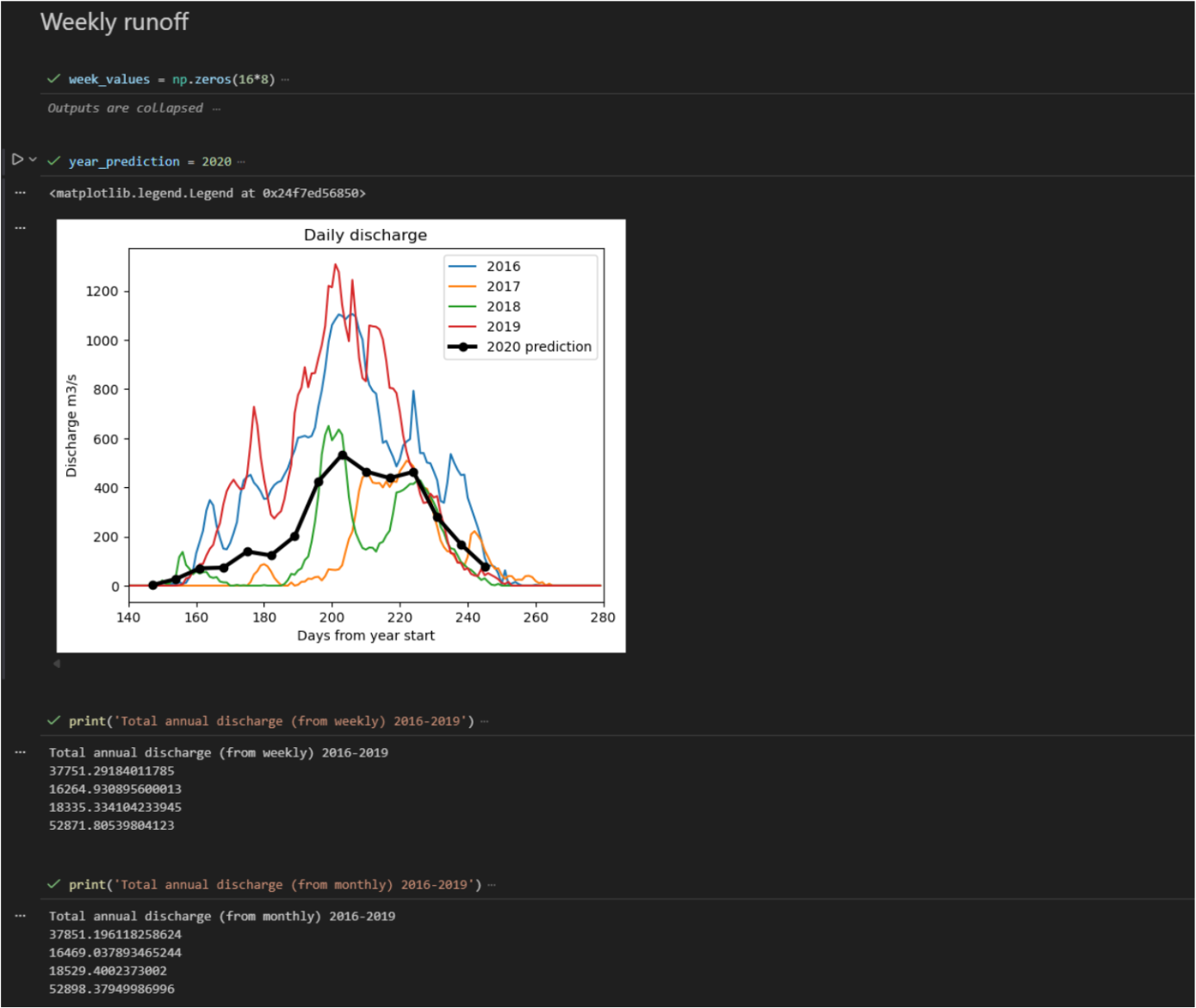
Excerpt from the Hydropower Jupyter Notebook Demonstrator.